Discover how engineering excellence, and offshore flow control innovation have driven Severn’s OCT TOV Butterfly Valve to deliver unmatched reliability in seawater service valve applications and harsh offshore environments.
Severn’s research & development team has designed a Butterfly Valve for Seawater Applications that solves the problem of galvanic corrosion in offshore systems and meets strict firesafe valve standards. Utilising over 65 years of engineering excellence in industrial valve design, the team of technical valve specialists achieved this by using Severn’s patented Oblique Cone Technology (OCT). The OCT‑SW Butterfly Valve takes this proven control and isolation valve technology to the next level by eliminating the need for graphite in the seal while maintaining full firesafe performance required for critical offshore safety systems.
What is galvanic corrosion and its costly effects?
The impact of galvanic corrosion in seawater valve systems on critical offshore assets due to marine process conditions is an enduring problem for offshore oil & gas installations, FPSOs, and sealine infrastructure. At best, it increases maintenance workload and repair activity during planned shutdowns. At worst, it can result in rapid or unexpected valve failure, leading to unplanned production downtime or emergency shutdowns.
Either way, galvanic corrosion presents a significant lifecycle cost risk that negatively impacts plant efficiency, operational reliability, and total cost of ownership. However, Severn has utilised its engineering heritage, in‑house R&D capability, and valve repair intelligence to develop a seawater butterfly valve solution that tackles galvanic corrosion head‑on.
Why does galvanic corrosion occur?
The cause of galvanic corrosion (also referred to as dissimilar metal corrosion or bimetallic corrosion) is an electrochemical reaction between two different conductive materials in close proximity within an electrolyte, such as seawater processing systems. One material – typically the least noble – is preferentially corroded.
In offshore valve design, the classic rule of “do not mix metals” is difficult to achieve due to extreme environmental conditions, fire safety requirements, and stringent materials specifications.
Modern offshore safety systems, such as firewater systems, must withstand continuous exposure to corrosive seawater, while delivering reliable isolation and control valve performance during normal operation and emergency conditions. Seawater service valves therefore play a critical safety role, making the elimination of galvanic corrosion while maintaining firesafe valve certification a long‑standing industry challenge.
The graphite challenge in seawater valve applications
In recent years, graphite sealing technology has become widespread in industrial valve manufacture due to its excellent thermal resistance, chemical stability, and flexibility. However, graphite is also the only non‑metallic electrical conductor and is more noble than many metals commonly used in offshore valve construction, including stainless steel, bronze, and titanium.
As a result, when graphite is exposed to seawater in contact with these metals, it can accelerate galvanic corrosion, particularly within seawater butterfly valves, control valves, and firewater isolation valves.
Traditionally, Severn’s Triple Offset Butterfly Valves utilised graphite in parts of their construction, which in seawater service applications could contribute to galvanic corrosion. Over time, this may compromise sealing integrity, valve reliability, and plant safety, potentially leading to costly unplanned outages.
Engineering a long‑term seawater valve solution
By working closely with offshore operators, EPC contractors, and end users, Severn identified this challenge and applied its extensive engineering heritage and technical valve design expertise to develop a long‑term solution.
The Severn engineering team designed a valve that either eliminates graphite entirely or isolates it completely from the line media, significantly reducing the risk of galvanic corrosion during normal operation. This ensures the highest levels of operational safety, asset protection, and system reliability, supporting the industry’s requirement for safe operations and minimal downtime.
OCT‑SW Triple Offset Butterfly Valve for Seawater & Firewater Systems
Severn’s OCT‑SW Triple Offset Butterfly Valve is a high‑performance seawater valve solution developed specifically for offshore sealine applications, firewater systems, and marine utility services.
These valves play a pivotal role in offshore safety systems, particularly where rapid isolation, reliable shut‑off, and firesafe operation are mandatory. Leveraging over 65 years of oil & gas valve engineering experience, the OCT‑SW valve has been designed to help operators meet their core objectives of safety, reliability, and reduced downtime.
Hybrid metallic‑polymer sealing technology
Severn has developed a hybrid polymer‑metallic sealing arrangement that removes the need for graphite laminates. By combining a primary metallic seal with a secondary polymer seal, Severn has:
- Eliminated graphite exposure to seawater
Increased isolation valve sealing performance
Maintained full firesafe valve certification
Furthermore, by ensuring that any remaining graphite gaskets and packings are fully isolated from the process media, the design prevents graphite and seawater from ever coming into contact. This eliminates galvanic corrosion risk, protecting production uptime, asset integrity, and operating efficiency.
Certified firesafe and ATEX‑compliant valve design
In addition to mitigating corrosion, Severn’s Butterfly Valves for Seawater Applications meet key firesafe testing standards, including:
- API 6FA
- API 607
- ISO 10497
This confirms the OCT‑SW valve as a certified fire‑safe valve, suitable for critical emergency scenarios.
The design also complies with ISO/IEC 80079‑36:2018 (ATEX) requirements, ensuring that static charge build‑up is eliminated and preventing any risk of spark generation. This makes the valve suitable for a broader range of hazardous area applications, extending beyond seawater service and reinforcing its versatility.
Materials, retrofitting & offshore suitability
The Severn OCT‑SW Butterfly Valve can be manufactured in a range of corrosion‑resistant materials, including:
- Aluminium Bronze
- Super Duplex Stainless Steel
- Titanium
Anti‑blowout protection is provided as standard. Available in standard and non‑standard face‑to‑face dimensions, with lugged and double‑flanged body styles, the valve can be easily retrofitted into existing offshore pipeline systems. This makes it an ideal upgrade solution for operators experiencing galvanic corrosion issues in seawater valve systems.
Severn’s engineering heritage and technical expertise have led to the OCT TOV Butterfly Valve being future-proof for changes in the process conditions to provide increased versatility for the end user seeking reliable high‑performance triple offset butterfly valves, industrial isolation valves, and severe‑service valve solutions.
From the outset, Severn made flexibility a key driving force in the design of the Oblique Cone Technology (OCT) Triple Offset (TOV) Butterfly Valve. Due to Severns extensive diverse engineering heritage and excellence, our expert team of engineers understand that processes and application product demands change over time, whether it is the process conditions or the overall requirements of the valve for the end user. Due to this understanding, the Oblique Cone Technology Triple Offset Butterfly Valve has been designed to incorporate multiple seal options, all fully interchangeable with each other, providing maximum application diversity and usability to ensure safe operations and minimum downtime making it ideal for oil & gas isolation, refinery valve applications, petrochemical process valves, and critical shutdown and control operations.
The Laminate seal is the “traditional” Triple Offset Valve seal and consists of multiple metal and graphite layers providing isolation sealing for high‑temperature, high‑pressure, and severe‑service applications.
The OCT HS seal is a hybrid polymer metallic seal, this seal benefits from a primary metal seal and secondary polymer seal, this provides a reliable and repeatable bubble tight seal time after time. This can also be paired with PTFE packings when graphite being in contact with the line media is a concern. The polymer seal is fully compliant with EN ISO 80079-36 (ATEX) making it an excellent choice for ATEX‑rated butterfly valves, hydrocarbon service valves, and zero‑leakage industrial valves.

The OCT SW Valve takes the hybrid sealing to the next level with its versatile high performance. Severn utilises the OCT-HS seal and has designed a valve that ensure there is no graphite in contact with the line media to remove the risk of costly galvanic effects such as internal corrosion leading to valve failure. Whilst doing so the OCT-SW also maintains firesafe certification making it suitable for Firesafe Triple Offset Valves, API 607 certified valves, and critical isolation applications in hazardous environments.

Should the sealing requirement not become as critical, and process conditions become more arduous, the Laminate and Hybrid seals can be changed for the OCT-SS solid seal. As the name suggests it is a solid metallic seal, that can be made from hard-wearing alloys to add longevity to the sealing life of the valve in arduous conditions and can offer a control valve seat leakage ideal for erosion‑resistant valve applications, abrasive service, and high‑cycle industrial operations.

Based on Severns comprehensive history of severe service control, our team of engineering experts work closely with operators and end uses to identify the correct seal and material selection to provide the maximum reliability and productivity further ensuring minimum downtime supporting industries such as LNG, chemical processing, power generation, and midstream pipeline operations.
All the OCT seals are interchangeable and can be upgraded without the need for main valve components being replaced, further emphasising the OCT TOV Butterfly Valves versatility. The fully in field serviceable valve can be upgraded on-site without the need for specialist tools or knowledge, this further ensures that costly unplanned downtime and site waste is kept to a minimum, along with potential loss in production for the end user. All the seal options can be changed on site within a small space of time to ensure site maintenance costs are reduced by upgrading the existing valve rather than discarding and replacing with a commodity product each time making it a cost-efficient solution for industrial valve maintenance, asset lifecycle extension, and retrofit valve upgrades.
Each OCT valve is specially designed to be versatile and ensure it has multiple purposes for multiple conditions whilst still delivering maximum performance. With the introduction of the interchangeable seal, these can be easily swapped out to match the end users’ requirements, should they change ensuring adaptability for future process changes, sustainability improvements, and long-term operational efficiency.
Incorporating over 65 years of engineering excellence and technical expertise in valve engineering and application, Severn Valves offers an industry leading and patented valve engineering technology solution(s) for Butterfly Valve requirements and applications with the Oblique Cone Technology (OCT) Triple Offset (TOV) Butterfly Valve. By utilising Severn’s ‘Repair Intelligence’ knowledge which involves providing real market feedback from extensive in-depth analysis from failed valves. Severn Valves have designed each facet of the OCT TOV Butterfly Valve to provide the most accurate, reliable, and robust service capability and performance possible to help the end user achieve their core remit of safe operations and minimum downtime.
Severn’s Triple Offset Butterfly Valve Cutting Edge Design Features Leads to Comprehensive Application Coverage.
Severn’s OCT Butterfly Valve design uses circular sealing geometry, unlike traditional triple offset butterfly valve designs that use an ellipse. The benefit of circular geometry is that it provides a uniform sealing load around the circumference of the sealing diameter, providing a reliable and repeatable shut-off. By using circles rather than ellipses, it allows Severn valves to use proven circular sealing knowledge and incorporate this into the TOV Butterfly Valve.
In addition, to this we can also add specialised flow control trims that are traditionally found on Severn’s double offset butterfly valves. These control trims include Anti Cavitation / Low noise, half baffle & full baffles. We can also add special features such as steam jacket and purge ports should they be required, onto our Triple Offset Butterfly Valve design.


Process conditions can change with time. Severn valves have ensured the interchangeability of the seal, should the sealing requirement not become as critical, or process conditions become more arduous. The HS seal can be changed to a laminated seal, or if conditions dictate, a solid seal. This can be done without the need for main valve components being replaced. The complete in-field serviceable valve can be upgraded on site without the need for specialist tools or knowledge ensuring possible down time and loss in production is kept to a minimum.
The interchangeability and versatility of the seal allows for Severn’s Triple Offset Valve to be used for both isolation and control applications and processes. The diversity of the OCT TOV Butterfly Valve and its functional usability for an extensive range of both isolation and control applications leads to the potential savings in stock holdings for end users who can use stock this one valve instead of stocking two. This in turn allows for potential cost savings for the end user on stock holding by reducing the need to stock multiple valves due to the extensive coverage that the OCT TOV Butterfly Valve offers.


Severn valve has designed all their Triple Offset Butterfly Valves with safety as paramount and therefore engineered the product with anti-blowout at both ends of the valve. This negates any chance of the shaft blowing out. The reduced shaft diameter at the drive end ensures the shaft cannot blow out through the packing follower and anti-blowout ring on the threaded shaft end ensures positive engagement without the need for additional fasteners.
The OCT range also comes with hard facing on the disc as standard with options to upgrade the standard hard facing to weld overlays such as stellite 6, ensuring and reliable seal and extended service life.
A quarter turn design ensures ease of actuation for both control and isolation purposes. Whether this be via an actuator or gearbox, the quarter turn design allows for simple operation.
As standard, Severn’s OCT TOV Butterfly Valve includes fugitive emission packing to ISO 15848 with options to change to meet customer specific requirements such as Shell 77/312 available.
The OCT valve range has been firesafe tested & certified in accordance with the strict fire test specifications set out in the standards ISO 10497, API 607 & API 6FA. Withstanding extreme temperatures of up to 1000°C whilst still sealing. Further underpinning the performance capabilities and validating the valve performance, ensuring this valve can be suitable for an extended range of applications and process requirements, leading to safe operations and reduction unplanned downtime for the end user.
Severn offer the OCT TOV Butterfly Valve in all cast materials. From basic carbon steels to specialist alloys such as Monel, Titanium & Hastelloy. Severn can provide the correct material selection for your application. Additional surface coatings such as stellite, armoloy, chrome or weld overlays are available upon application and request.
Fireproof Assurance: Severn’s OCT TOV Butterfly Valves Exceptional Fire Safety Design and Testing Credentials
As part of a safety‑first valve design approach, Severn incorporates into its innovative Oblique Cone Technology (OCT) Triple Offset (TOV) Butterfly Valve, fire safety is a critical part of that safety first objective. Fire testing standards state the minimum requirements the valve must achieve in order to receive fire safe certification. The standards dictate the setup & parameters required to simulate the conditions a valve may be subjected to during a hydrocarbon fire scenario, and test to ensure the valve can operate satisfactorily afterwards.

To summarise, the test consists of a valve being mounted in a fire testing rig to flow water through the valve, and measure leakage both internally past the seal as well as externally through the packings and gaskets. The valves are then pressure tested at ambient temperature, once the valve has passed this element of the test, any leakage is recorded. The valve is then subject to a simulated fire by use of gas burners, with average temperatures of between 750°C & 1000°C recorded by thermocouples for the 30‑minute fire test duration. Once complete, the flames are extinguished, and the valve is subjected to a forced cooldown using water to simulate the fire being extinguished on site.
The leakage during fire is measured and recorded. The valve is then subject to a re‑ambient temperature and post‑fire operational test, with the maximum leakage requirements being defined within the relevant API and ISO fire safety standards. The tests are carried out in both the preferred and reverse directions and are witnessed by a 3rd party approval body, giving added confidence that the fire tested butterfly valve will perform as required in either flow direction.
By investing in and developing their own on‑site fire test facility, Severn can understand and interpret the results to re‑design & develop the fire safe valve technology for the OCT TOV Butterfly Valve, to further exceed the requirements set out in the standard. By doing this, Severn have been able to achieve up to zero seat leakage, even after API 607, API 6FA and ISO 10497 fire testing, giving further confidence in safety‑critical valve applications and ensuring a safety‑first solution for the end user and their operations.
The key to Severn’s success lies in their patented Oblique Cone Technology (OCT), which received approval from the UK Intellectual Property Office in 2018. This innovative triple offset valve design uses an ‘infinite circle’ geometry that allowed the research and development team to develop the circular sealing geometry, providing the flexibility to use the valve for both control and isolation duties, with the option of interchangeable seals and control trims.
Utilising its over 60 years of valve engineering expertise, Severn have designed and developed the innovative OCT TOV Triple Offset Butterfly Valve, a valve that meets the requirements of API 6FA, API 607, and ISO 10497 fire testing standards. These bi‑directional isolation and control valves offer repeatable zero leakage performance, providing peace of mind for operators while ensuring safe operations and reduced downtime.


Severn’s fire test certification covers the OCT Laminate, Hybrid (OCT‑HS) and Seawater (OCT‑SW) seals, achieving the required leakage rates in accordance with relevant international fire safety standards. By designing, developing, and testing the hybrid polymer metallic fire safe seal, Severn have been able to deliver a graphite‑free firesafe sealing solution that continues to perform even after exposure to extreme fire conditions. The OCT‑SW seal technology, designed for seawater service, prevents graphite contact with line media, eliminating galvanic corrosion risks and extending valve service life.

By meeting stringent fire testing and certification requirements, Severn provide customers with a reliable and proven fire safe butterfly valve solution. With its patented oblique cone technology, Severn has set a new benchmark in triple offset valve design, helping end users achieve their core objective of safe operations, asset protection, and reduced downtime.
Exploring the innovative features and engineering principles of Severn’s OCT TOV Butterfly Valve that puts safety first in safety‑critical valve applications.

At Severn, safety is paramount in the design of our products. With our background in safety‑critical industries such as oil & gas, petrochemical and process plants, Severn understands the importance of safety‑first valve design for both our customers and employees.
As well as adhering to the strictest international valve safety standards, Severn have identified that shaft blowout prevention was paramount to our end users and the wider industrial valve and process industries, for improved valve performance and reduced operational downtime.
Butterfly Valve shafts are designed to connect to the disc with either dowel pins, taper pins, or keyways. The separation of the shaft and disc in service can be catastrophically dangerous in high‑pressure and safety‑critical valve applications. If any of these parts fail, the shaft may be ejected from the valve body. Shaft blowouts can occur when a coupling mechanism fails, therefore, disconnecting the shaft from the disc. With the pressures in the system, it may eject the unrestrained drive shaft through either end of the valve.
Not only is this projectile a huge safety concern but has the potential to compromise the pressure envelope of the valve allowing hazardous process media to escape into the atmosphere.
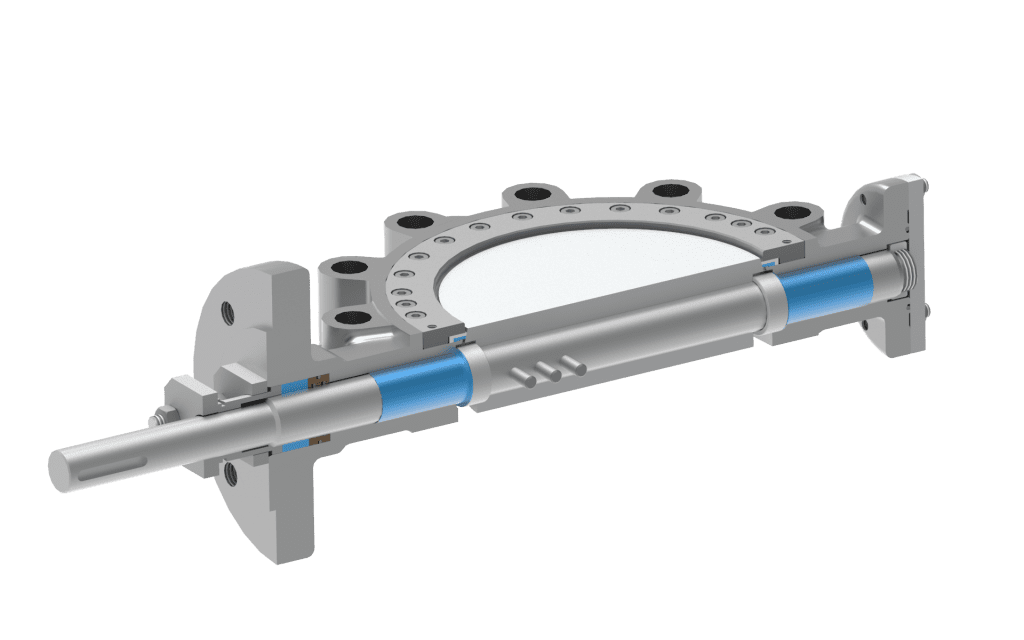
Severn has designed all their Triple Offset Butterfly Valves as standard with dual anti‑blowout protection, incorporated at both ends of the valve. This negates any chance of the shaft blowing out if the pins were to fail. The reduced shaft diameter at the drive end ensures the shaft cannot blow out through the packing follower, significantly improving operator and plant safety.
On the blank end of the valve, Severn have multiple engineered anti‑blowout features, which prevent shaft blowout. The anti‑blowout ring on the threaded shaft end ensures positive engagement without the need for additional fasteners. The blank end plate is locked in place and is designed to withstand full rated test pressures in severe service conditions.
Dual anti‑blowout devices are standard on the OCT TOV Butterfly Valve, meaning that even if the gland is removed, the secondary internal anti‑blowout device will stop ejection of the shaft under pressure, further enhancing industrial valve safety and reliability.
Severn have designed their Triple Offset Butterfly Valves to exceed the minimum wall thicknesses stated in ASME B16.34 valve design standards. Instead of using only the minimum allowance, Severn have engineered additional material to ensure improved pressure containing integrity and long‑term safety performance in the field.
Within Severn’s Triple Offset OCT TOV Butterfly Valve, there is a corrosion allowance. This means that the valve can afford to concede material to corrosion over time without affecting the pressure‑containing integrity or safety of the valve. The amount of corrosion may vary depending on the environment the valve is operating in, but due to Severn’s engineering heritage and design excellence, the OCT TOV Butterfly Valve has been designed to withstand changes in process conditions and operating environments.
High MAST (Maximum Allowable Shaft Torque) figures and safety factors are key when designing quarter‑turn butterfly valves for severe service. MAST represents the Maximum Allowable Shaft Torque a valve shaft can withstand during operation without mechanical failure. By utilising higher MAST figures, Severn helps maintain the structural integrity and mechanical safety of the valve throughout its service life.

Sizing actuators correctly is a credit to Severn’s engineering‑driven valve design approach. Actuators, gearboxes, or other valve drives must be sized correctly using accurate input and output torque values. By torque testing physical valves prior to final inspection, Severn compares real operating torques against theoretical calculations, ensuring accuracy, consistency and reliable valve automation performance across the range.
Safety has always been at the forefront of Severn’s designs, and this commitment is paramount in the 8500 OCT Triple Offset Butterfly Valve range, delivering confidence, compliance and reliability for safety‑critical applications worldwide.
Severn’s engineering heritage and excellence in valve manufacturing has led to the innovative design of a product that can master both Control & Isolation applications within critical flow control systems.
Utilising Severn’s long history with Control Valve design, our team of valve engineering experts have been able to manufacture a Triple Offset Butterfly Valve that can be used to provide superior flow control performance in both throttling and modulating service, whilst additionally providing a repeatable, bubble‑tight seal for isolation valve duties.
By designing a Control Valve that can isolate, rather than an isolation valve that attempts to control (which may initially sound similar but is fundamentally different in performance outcome), Severn has developed a high‑performance butterfly valve that maximises Cv through streamlined internal geometry. This delivers optimal flow characteristics, improved process controllability, and stable valve performance under variable operating conditions.
This distinction is critical for industries requiring precise process control, reliable shut‑off, and long‑term operational safety, particularly within oil & gas, energy, offshore, chemical processing, and industrial fluid handling systems.
Designing for Reliability, Safety, and Performance
Severn has eliminated the need for disc fasteners or bolted‑on seals, allowing further optimisation of the disc profile. By removing fasteners from the disc:
- Flow efficiency is improved
- Pressure drop is reduced
Risk of loose components entering the pipeline due to vibration is eliminated
This approach significantly enhances operational reliability, particularly in high‑vibration and severe service environments.
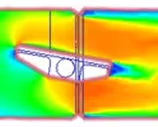
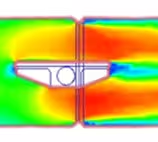
By adopting a body‑mounted sealing arrangement, Severn has increased both the longevity and reliability of the valve. Removing the seal from the direct flow path of the process media reduces wear, enabling Severn to:
- Increase effective bore size
- Maximise Cv
- Extend service life in demanding applications
Patented Oblique Cone Technology (OCT)
Using Severn’s Patented Oblique Cone Technology (OCT), the valve utilises circular sealing geometry that ensures an even seal load distribution around the circumference of the disc.
This technology provides:
- Repeatable bubble‑tight shut‑off
- Improved operational safety
- Enhanced process reliability
- Reduced downtime and maintenance intervention
Ensuring customers consistently meet their core remit of safe operations and minimum downtime.
Advanced Trims for Severe Service Conditions
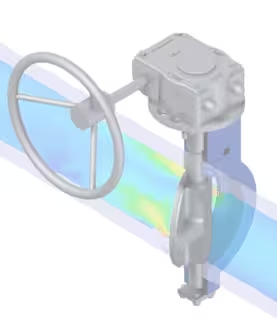
The OCT geometry enables Severn to offer an extensive range of control valve trims not traditionally associated with Triple Offset Butterfly Valves.
- By utilising a one‑piece disc design, Severn can incorporate:
- Anti‑cavitation trims
- Noise‑reduction solutions
- Flow conditioning elements
- Baffle plates for severe service control
This allows the valve to operate effectively in high‑pressure drop, high‑velocity, and erosive flow conditions, where a conventional butterfly valve would typically suffer reduced service life or performance limitations.
Reduced Inventory, Lower Costs, Greater Efficiency
- The OCT Triple Offset Butterfly Valve can be utilised for both control and isolation valve applications, enabling end users to:
- Reduce valve stock inventory
- Standardise spare parts
- Lower overall operating costs
- Simplify maintenance strategies
Standardised and interchangeable components further reduce spares holding requirements, delivering measurable lifecycle cost savings.
It also provides end users with the option to utilise a single valve to perform both control and isolation functions within a system, rather than two separate valves. This results in:
- Reduced CAPEX and OPEX
- Lower system weight
- Simplified piping design
These benefits are particularly critical for weight‑sensitive applications such as offshore installations, FPSOs, and platform‑based processing facilities.
Discover how Severn’s high‑performance control and isolation valve solutions can enhance your operation.
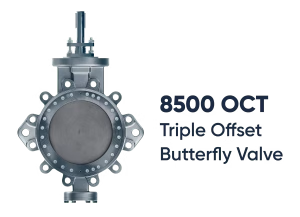
With over 60 years’ experience in the design and manufacture of high‑performance butterfly valves, Severn launches a range built on decades of learnings and innovative engineering for the process, oil & gas, energy, and power generation industries.
In the dynamic landscape of industrial valve engineering, innovation often stems from a rich heritage of expertise and an unyielding commitment to excellence. Severn Glocon, a renowned name in the world of valve design and manufacturing, have once again proven this statement true with the unveiling of the superior Oblique Cone Technology (OCT) Triple Offset (TOV) Butterfly Valve.
This development represents Severn’s ongoing commitment to advanced valve technology, process reliability, and operational efficiency in the process and industrial energy markets, promising enhanced performance, long‑term reliability, and reduced lifecycle cost.
Engineering Heritage: The Foundation of Excellence
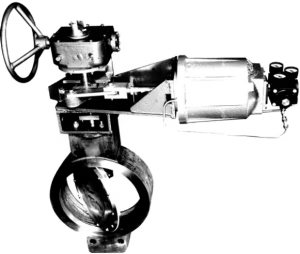
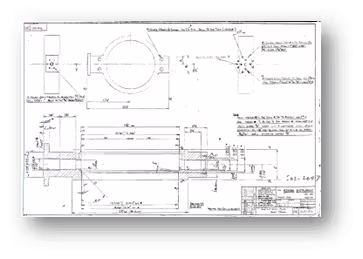
Severn’s journey to engineering eminence is woven with a tapestry of innovation and dedication stemming back over 60 years. With an engineering history extending back to 1957 and the design and manufacturing of globe control valves, Severn has continuously pushed the boundaries of industrial valve design, earning a reputation for precision engineering, high‑integrity products, and global project delivery.
Drawing from this extensive engineering heritage, Severn has consistently delivered valve solutions for critical service applications that exceed industry standards and address the evolving needs of diverse sectors including oil & gas refineries, chemical processing plants, and power generation facilities.
Unveiling the Oblique Cone Technology (OCT)
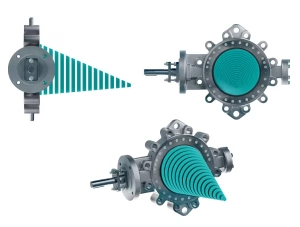
At the heart of Severn’s latest engineering triumph lies the OCT TOV Butterfly Valve, a revolutionary advancement in triple offset butterfly valve design and performance. Unlike traditional butterfly valves, which often suffer from limitations in sealing integrity, repeatability, and durability, the OCT TOV Butterfly Valve introduces circular sealing geometry.
Unlike traditional triple offset designs that use an ellipse, the benefit of circular geometry is that it provides a uniform sealing load around the circumference of the sealing diameter, delivering a reliable, repeatable bubble‑tight shut‑off.
By using circles rather than ellipses, Severn is able to apply proven circular sealing principles and incorporate these into the TOV, delivering a high‑performance isolation valve suitable for severe service conditions and critical process applications.
Repair Intelligence: Designed for Real‑World Performance
Incorporating Severn’s proprietary Repair Intelligence® knowledge — derived from extensive field feedback and forensic analysis of failed valves — each aspect of the OCT TOV Butterfly Valve has been optimised for accuracy, robustness, and long‑term service reliability.
Whether managing critical processes in oil & gas refineries, chemical plants, or power generation facilities, the OCT TOV Butterfly Valve ensures end users achieve their core remit of safe, compliant operations, minimum unplanned downtime, and reduced maintenance intervention.
Advantages for Process and Industrial Energy Markets
The introduction of the innovative OCT TOV Butterfly Valve signifies a paradigm shift in industrial valve technology, offering measurable operational advantages:
Enhanced Performance:
Severn have designed each facet of this valve to provide the most accurate, reliable, and robust service capability possible, supporting plant uptime optimisation and process stability.
Extended Lifecycle:
Process conditions change over time. Severn have ensured seal interchangeability, allowing users to adapt sealing configurations as operating pressures, temperatures, or service severity evolve — extending valve service life and reducing total cost of ownership.
Increased Safety:
Safety is paramount to Severn’s valve design philosophy. In addition to meeting the strictest industry standards, shaft blowout prevention has been incorporated to enhance safety for end users and the wider industry.
Versatility:
Leveraging Severn’s engineering excellence, the OCT TOV Butterfly Valve delivers superior control in throttling and modulating applications, whilst also providing a repeatable isolation seal, making it ideal for multi‑service duties.
Environmental Sustainability:
Supporting reduced fugitive emissions and tightening environmental regulations, all Severn OCT triple offset butterfly valves are supplied with fugitive emissions packing sets as standard, helping end users meet compliance targets with confidence.
Setting New Benchmarks in Butterfly Valve Technology
Severn’s relentless pursuit of engineering excellence has culminated in the development of the OCT Triple Offset Butterfly Valve — a testament to the company’s commitment to innovation, customer satisfaction, and long‑term asset performance.
As industries worldwide seek high‑integrity valve solutions to meet increasingly complex operational demands, Severn Glocon stands ready to lead the way, setting new benchmarks for performance, reliability, and efficiency in industrial valve technology.
Severn’s patented OCT TOV butterfly valve technology advances traditional triple offset valve (TOV) sealing technology even further, maximising sealing performance for critical flow control applications and high‑integrity isolation valves.
The Oblique Cone Technology (OCT) moves away from the traditional elliptical sealing shape and introduces a circular sealing geometry, enabling proven double offset butterfly valve sealing principles to be applied within the Severn OCT TOV Butterfly Valve design. This makes it ideally suited for high‑performance butterfly valves, severe service valve applications, and demanding process control environments.
In addition, trims traditionally associated with double offset butterfly valves — such as anti‑cavitation trims for control valves — can be incorporated into the TOV butterfly valve design. This versatility positions Severn’s OCT TOV Butterfly Valve as an ideal solution for combined isolation and control valve applications, where process stability, accurate flow regulation, and reliable shut‑off performance are essential.
Hybrid Sealing Technology – Advancing Butterfly Valve Performance
Severn’s significant investment in control valve research and development has been instrumental in introducing hybrid sealing technology into the OCT TOV butterfly valve.
By combining a hybrid polymer‑metallic valve seal, Severn applies the self‑compensating sealing benefits of triple offset valve technology to a polymer sealing system. The addition of a metallic sealing element ensures that if the soft seal becomes damaged during operation, the metal seal automatically engages, continuing to provide a reliable zero‑leakage butterfly valve seal.
This fault‑tolerant butterfly valve sealing system makes the OCT TOV butterfly valve particularly suitable for:
- Challenging and variable process conditions
- Severe service valve applications
- High‑cycle control valve duties
Proven Testing and Validation
The hybrid butterfly valve sealing system has undergone an extensive and rigorous testing programme, including:
- High‑cycle endurance testing
- Fire‑safe valve testing
- Extreme operating condition validation
These tests confirm that even in harsh operating environments, the OCT TOV Butterfly Valve delivers a high‑integrity sealing solution.
This level of performance would not be achievable with a conventional double offset butterfly valve, where seal damage typically necessitates seal replacement, resulting in unplanned plant downtime, increased maintenance intervention, and potential production losses.
Self‑Compensating Design and Reduced Wear
Severn’s OCT TOV Butterfly Valve is fully self‑compensating for wear, ensuring consistent sealing performance throughout the valve lifecycle.
The third‑offset camming action significantly reduces seal wear by minimising seal contact. Disc‑to‑seal contact occurs only during the final 1–2 degrees of valve closure, substantially lowering operating torque, friction, and mechanical wear.
In comparison, a standard double offset butterfly valve typically maintains seal contact over approximately 10 degrees of rotation, leading to increased wear and reduced long‑term reliability.
Built‑In Safety and Compliance
The standard OCT TOV Butterfly Valve design incorporates the requirements of the most stringent international valve standards.
Key safety features include a dual anti‑blow‑out shaft design, supplied as standard, ensuring the valve shaft cannot be ejected during operation — enhancing plant safety, asset protection, and operational integrity.
The hybrid polymer valve seal is fully compliant with EN ISO 90079‑36 (ATEX) requirements, making the valve suitable for hazardous area installations and ATEX‑rated process applications.
In‑Field Serviceability and Future‑Proof Design
Severn recognises that operating conditions can evolve beyond original design assumptions. To address this, the OCT TOV butterfly valve sealing system has been engineered with interchangeable seal options.
Where required, the hybrid seal can be replaced in‑field with a laminated seal or a solid metal seal — without replacing the main valve body or major components.
This ensures the OCT TOV Butterfly Valve remains:
- Fully serviceable in the field
- Upgradeable to suit harsher process conditions
- Optimised for safe operation, improved plant reliability, and reduced maintenance downtime
Find out more about Severn’s OCT TOV Butterfly Valve, advanced butterfly valve sealing solutions, and high‑performance isolation and control valves by visiting our website via the link below.