
A Technical Overview of Design, Safety, and Corrosion Considerations of Butterfly Valves Tackling Galvanic Corrosion in Fire Water Systems
Galvanic Corrosion: The hidden risk that provides costly challenges for operators
Thankfully strict safety protocols have been put in place by operators, meaning the greatest problem for these butterfly valves is failure due to corrosion rather than through heat. An increasing number of assets are seeing the failure of these critical valves after a few years. Up to now the solution has been to replace the valve like for like and implement a maintenance schedule as part of the planned TAR’s. This is not only inefficient but can be expensive. But, with the graphite isolated solution of Severn’s OCT-SW valve, there is now a superior solution.


What is Galvanic Corrosion?
Galvanic Corrosion occurs when two dissimilar metals are in electrical contact in the presence of an electrolyte (e.g., seawater). The more active (less noble) metal corrodes preferentially.
- Graphite: Highly noble and acts as a cathode.
- Metallic Valve Components: Act as the anode and corrode.
- Result: Accelerated degradation of valve components, especially at sealing interfaces.
Nobility of materials
The term “nobility” of materials refers to a material’s resistance to corrosion, oxidation, and other forms of chemical degradation. Noble materials, like gold and platinum, are highly unreactive and do not easily combine with other elements. Conversely, “active” or “base” materials, such as iron and zinc, are more reactive and prone to corrosion.
Galvanism can be traced back to the 18th century when physician Luigi Galvani discovered that an electrical current could be created from a chemical reaction. His research laid the groundwork for the study of chemical electricity, or “galvanism”.
Following Galvani’s work, Alessandro Volta invented the first battery by stacking discs of two different metals separated by a salt-soaked material. This demonstrated that a sustained electric current could be created from the chemical interaction between dissimilar metals in an electrolyte. Scientists soon made the link and established this phenomenon to corrosion. They discovered that when two dissimilar metals were in electrical contact and exposed to an electrolyte (like saltwater), one metal would corrode more quickly than it normally would, while the other would be protected.
The modern scientific concept of nobility is derived from centuries of practical human experience with different metals.
The Galvanic Series
- Ranking by potential: The empirical observation of this galvanic effect led to the development of the galvanic series (or electro potential series). In this series, materials are ranked from “active” (most reactive and prone to corrosion) to “noble” (least reactive and most resistant to corrosion).
- Electrode potential: This ranking is based on a material’s electrode potential, which is a measure of its tendency to gain or lose electrons. More active metals have a lower (more negative) potential, while noble metals have a higher (more positive) potential.
Today, engineers and scientists use the galvanic series to predict how different materials will interact in a corrosive environment. By understanding how this process works. Appropriate materials can be selected or ideally removed to stop the galvanic corrosion happening.
The Issue With Valves….
The use of graphite as a sealing mechanism is widespread across numerous industries due to its excellent sealing properties, chemical resistance, and ability to withstand extreme temperatures. However, in marine environments, particularly when exposed to seawater, its highly noble (cathodic) nature poses a significant risk of galvanic corrosion to the less noble (anodic) metallic components it contacts. This phenomenon is a major concern for offshore and maritime operators, as it can lead to compromised seal integrity, costly equipment damage, and unplanned downtime.
In a seawater-exposed assembly, a metallic component—for instance, a stainless-steel flange or valve stem—acts as the anode. The adjacent graphite gasket or packing acts as the cathode. The seawater completes the electrical circuit, drawing electrons from the less noble metal (the anode) and transferring them to the more noble graphite (the cathode). This leads to an accelerated dissolution of the anodic metal, concentrating the corrosion damage at or near the seal interface.
A particular concern is the combination of graphite with stainless steels. While austenitic stainless steels (e.g., 316L) are generally more resistant to corrosion, they are not immune. Some industry standards, such as NORSOK, even prohibit the use of graphite in sealing materials for offshore applications to eliminate this corrosion risk. Material selection is critical for valves on this duty. By utilising materials like Super Duplex or Aluminium Bronze, using hard facing on critical sealing faces and hard wearing seal materials, Service life for this critical application can be significantly increased.
Engineering Out Corrosion
The most definitive solution to prevent galvanic corrosion is to remove the graphite seal and replace it with a non-conductive alternative. Recent developments in sealing technology have introduced advanced materials specifically designed for demanding seawater applications where galvanic corrosion is a risk.
Modern valve designs, such as the Oblique Cone Technology (OCT-SW) Triple Offset Butterfly Valve, have been engineered to ensure graphite parts do not come into contact with the seawater, effectively isolating the corrosive elements from the line media and have solved this issue with patented and advanced Butterfly valve technology. The shift toward graphite-isolated technologies represents the most robust and sustainable solution for ensuring safety, extending equipment life, and reducing maintenance costs in demanding and safety critical seawater applications.

Initial Investment vs overall cost of ownership
It’s often a false economy with the old saying that “buy cheap, buy twice” but the cost and implications of buying cheap can be much worse. Greenfield sites can often be driven very much on cost, with the priority of building the new platform or vessel being that if it meets specification, lets buy the cheapest. But is the specification right and is the most cost effective to buy, the most cost effective overall?
Wrongly specified valves can often fail prematurely due to poor material selection or even be designed as throwaway items designed to last until the next TAR or service interval. But what happens if they don’t last and fail prematurely? What is the true cost unplanned downtime of replacing the valve on a critical safety system such as a fire water line.
Worst case scenario is that operations must stop, if it’s not safe to operate, production can be halted resulting in $millions in lost production until the valve can be replaced. If it’s deemed that it’s safe to operate, but the valve must be replaced urgently, mobilising costs, replacement valves, and the logistics of shipping valves offshore can run into hundreds of thousands of dollars.
All these costs and risks can be mitigated, by investing in the best solution initially, or for existing plants to upgrade to a better solution. By selecting a valve that’s been designed specifically for the application and materials that have been optimised for the media, unplanned downtime can be a thing of the past.
Severn’s OCT valve has been designed to be repaired and not replaced. The highest cost of the valve is often the main components such as the body and disc, often the best material for seawater service is exotic materials such as Super Duplex, Aluminium Bronze or can even extend to Hastelloy’s and Titanium for more severe applications where issues are known. By protecting the critical sealing surfaces by hard facing, it means that when the valves do need to be serviced, it can be done by replacing soft goods only, not just once, but time after time.
The engineered design of the OCT-SW means that valves can be overhauled on site with only basic tools, valves can be removed from line, overhauled and re-installed within hours. By repairing the valve, it also reduces waste and helps the operators meet ESG targets. It also further reduces costs associated with waste management and shipping waste back onshore. In summary, investing in the correct and most appropriate solution from the outset, may cost a little more that the “off the Shelf one size fits all” solution, but the overall savings could be millions.
Conclusion
Firewater systems are mission-critical safety assets. Every component must perform under extreme conditions—especially Isolation valves. Specifying fire-safe certified and corrosion-resistant valves is essential for:
- Personnel Safety
- Asset Protection
- Regulatory Compliance
- Operational Continuity
- Reduced Downtime
- Managing Environmental Risks
Severn Glocon’s OCT-SW valve exemplifies how advanced engineering can deliver robust, long-term solutions for offshore & coastal facility firewater systems. This solution can not only significantly reduce the overall cost on ownership and increase service life, but more importantly increase plant safety and reduce risk.
A Technical Overview of Design, Safety, and Corrosion Considerations of Severn’s Butterfly Valves In Fire Water Systems
Butterfly valves in Fire water systems are critical safety infrastructures on offshore oil rigs, onshore coastal facilities and floating production, storage, and offloading (FPSO) vessels. Unlike inland-based systems that rely on municipal water supplies, offshore, vessels & coastal facility fire systems draw seawater directly from the surrounding environment. This requires specialised equipment and robust corrosion control strategies to ensure long-term reliability (and minimise potential critical safety risks). These safety systems are designed with multiple layers of defence to address a range of fire scenarios—from minor hydrocarbon spills to large-scale fires that can potentially threaten life and cause large scale environmental impact. The integrity of each component is vital to the system’s performance during emergencies.
Key Components of Firewater Systems
- Firewater Pumps: The heart of the system, these pumps draw in large volumes of seawater and pressurise it into the firewater ring main. Offshore facilities typically use two or more pumps for redundancy, powered by independent diesel engines or hydraulic units to ensure operation during power loss.
- Jockey Pump: A smaller pump that maintains system pressure during standby conditions, preventing unnecessary cycling of the main pumps.
- Pump Configurations: Options include submerged caisson-type pumps and dry-mounted diesel-hydraulic pumps, depending on platform design and operational requirements.
- Firewater Ring Main: A looped network of large-diameter piping that distributes pressurised seawater across the facility. Constructed from corrosion-resistant materials such as copper-nickel (Cu-Ni), glass-reinforced plastic (GRP), or titanium, the ring main ensures water delivery even if part of the system is compromised.
- Deluge Systems: Automatically activated by fire and gas (F&G) detection systems, these systems release water or foam through open nozzles to suppress fires in high-risk zones.
- Foam Systems: Used for flammable liquid fires, foam is mixed with water in a proportioning device and delivered via deluge systems or foam monitors. Fluorine-free foams (FFF) are increasingly adopted for environmental compliance.
- Monitors and Hydrants: High-capacity water cannons and strategically placed hydrants enable manual firefighting and localised response.
Emergency Operation of Firewater Systems
In the event of a fire, the firewater system is automatically activated through a sequence of coordinated actions:
- Fire Detection: Sensors within the integrated Fire and Gas (F&G) detection system identify heat, smoke, or flame signatures.
- Alarm and Response: Upon detection, the system triggers an alarm and initiates the firewater pumps, drawing seawater and pressurising the ring main.
- Deluge Activation: Deluge valves open rapidly, often before the pumps reach full pressure. The system is designed to accommodate this pressure surge to prevent pipework damage.
- Fire Suppression: Water, or a water-foam mixture, is discharged through nozzles or monitors to suppress the fire, cool surrounding equipment, and prevent escalation.
- Emergency Shutdown (ESD): In severe incidents, the Emergency Shutdown system isolates hydrocarbon sources and halts processing operations to contain the hazard.
The Importance of Fire-Safe Certified Isolation Valves
While pumps and piping are vital, the reliability of Isolation valves is equally critical. These valves must maintain integrity under extreme heat to ensure uninterrupted water delivery during a fire.
The reality is that some fire water systems were (are) built and specified with either rubber lined valves or non-fire safe certified valves meaning that either costs have been prioritised over safety, or criticalness of the application hasn’t been appreciated, and although the chances of an incident are small, the consequences could be fatal. Rubber lined valves are often specified as they can significantly reduce costs, cheaper body materials such as cast iron and carbon steel can be used as the rubber prevents the seawater contacting this, these valves will function correctly until an emergency occurs and the rubber melts or burns away. The valves are then rendered useless and will not perform the function they are needed to perform during this crucial time. This can lead to loss of system pressure, or leaks, meaning the relevant sections of pipe cannot be isolated, the water pressure isn’t high enough or the water cannot be directed to where is needed to extinguish the fire. This is not just for rubber lined valves, but it is also the same for other non-firesafe designed and certified Butterfly valves.
Operators must ensure that the highest levels of safety are maintained and critical to this, it means ensuring the correct valves are specified for safety critical applications. These choices can stem from cost-saving measures or a lack of understanding of the application’s criticality. However, the consequences of valve failure during a fire can be catastrophic.
Fire Risks and Valve Failure Modes
Standard Isolation valves often use polymer-based components (e.g., PTFE seats and seals) that degrade at fire temperatures (750°C–1000°C). This can lead to:
- External Leakage: Loss of sealing allows pressurised water to escape, reducing firefighting effectiveness.
- Internal Leakage: Through-seat leakage compromises isolation, potentially flooding unintended areas.
Loss of Operability: Heat distortion can jam the valve, preventing manual or remote operation.
Fire-Safe Certification Standards
To mitigate these risks, valves must be tested and certified to recognise fire-safe standards:
- API 607: For quarter-turn valves with non-metallic seats.
- API 6FA: Covers metal-seated valves under fire conditions.
- ISO 10497: International fire type-testing standard.
Typical Fire Test Procedure:
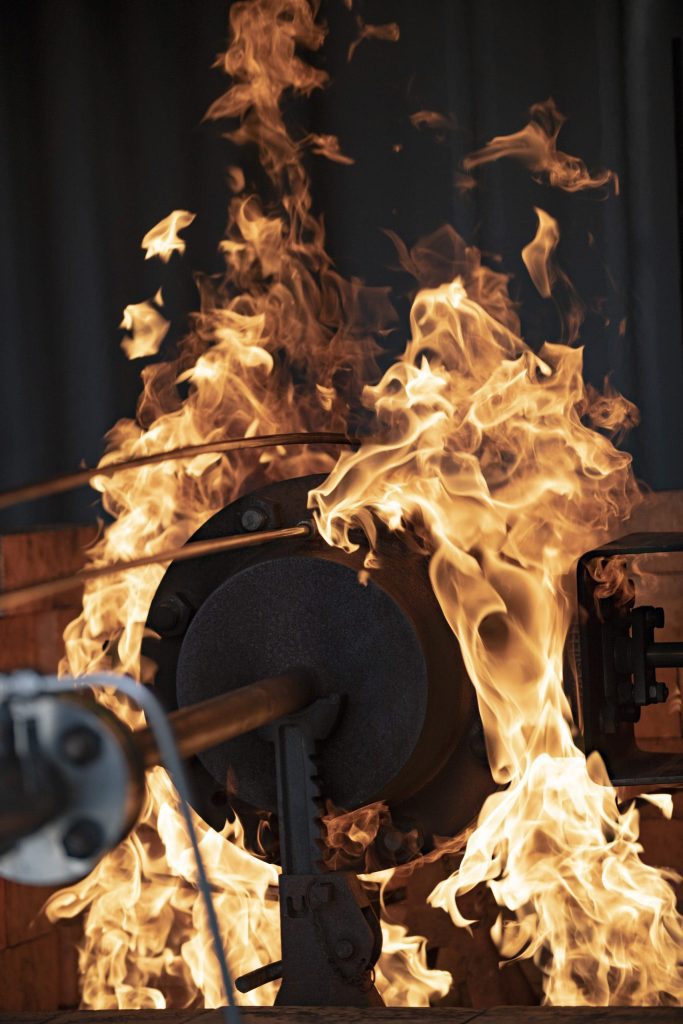
- Preparation: Valve is pressurised to 75% of its rated pressure and closed.
- Fire Exposure: Valve is engulfed in flames for 30+ minutes at 750–1000°C.
- Cooling and Inspection: Leakage is measured post-burn.
- Operability Test: Valve must be cycled open and closed to confirm functionality.
Severn’s Butterfly Valves in Fire water – Safe Valve Design Options
Several valve designs are available at Severn Butterfly Valves in fire water systems, each with distinct advantages and limitations:
Severn Double Offset Valves
Firesafe certified Double offset valves, these are generally designed with a primary polymer seal and metallic backup metal seal, this means that in the event of a fire the PTFE seal can burn away or melt, and the metal seal will then come into contact sealing face; the risks are that if the polymer doesn’t fully carbonise or flow away from the secondary metal seal it risks becoming jammed between the two sealing faces and can stop the valve from closing fully, causing an internal leak. These valves have graphite packings and gaskets to prevent external leakage in the event of a fire.
Severn Triple Offset Valves
This torque seated valve is the preferred option and provides metal to metal torque seating. This design uses metallic and graphite to provide leak tight sealing in the event of a fire. The negatives of this are that, when used in seawater applications, galvanic corrosion can occur causing premature failure of the valves, further details of what galvanic corrosion is and the issues are explained later in this article. There is however another option:
Severn’s OCT-SW Valve: A Graphite-Isolated Solution
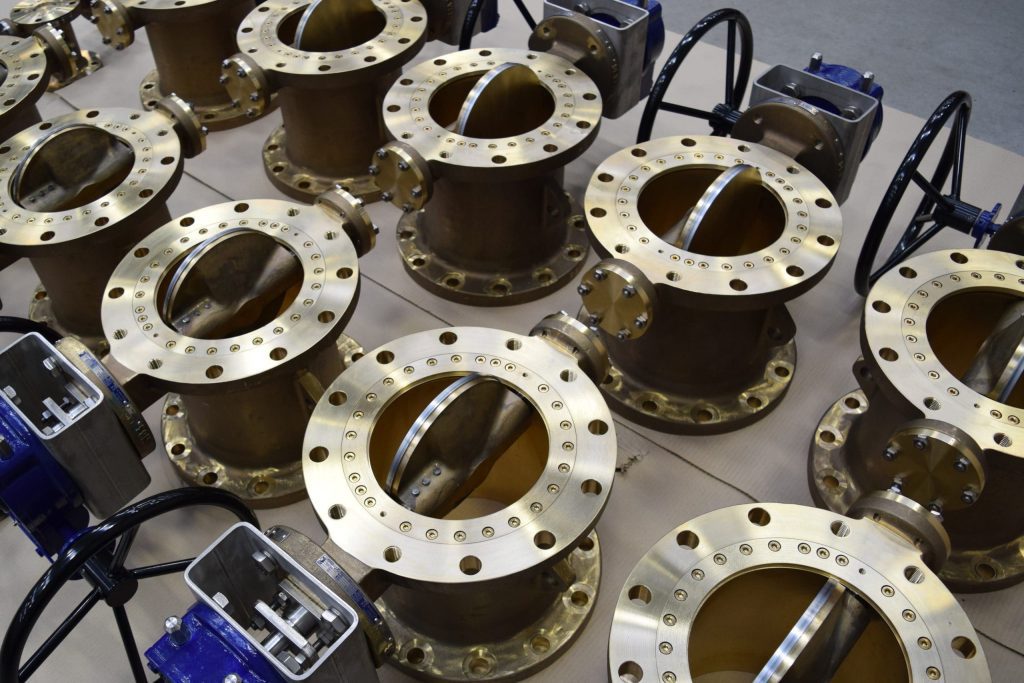
Developed by Severn Glocon, Oblique Cone Technology is a patented triple offset valve design, enhanced further with graphite isolated parts for Sea Water service the OCT-SW valve addresses both fire safety and corrosion resistance:
By using the same principals as a standard Triple Offset valve, but enhancing this further with patented design technology and understanding the headaches galvanic corrosion can cause for operators. With the OCT-SW, all graphite components are isolated from contacting the line media during normal operation, eliminating the risk of galvanic corrosion. But as they remain within the valve design, they provide reliable sealing in the event of a fire.
The OCT-SW design uses a primary metal seal, and polymer back-up seal. By using the metal as a primary seal and torque seating the disc closed, it means that the metal seal does 99% of the valve sealing, meaning that the Polymer seal is only there to provide the last 1% and ensure full zero leakage isolation. What this means is that in the event of a fire, if the polymer, deforms, melts or carburises, the metal-to-metal seal still remains and provides a tight dependable seal.
Adopting a metal-to-metal torque seated design, means that even when exposed to the extreme heat of a fire the polymer seal cannot flow between the two metal sealing surfaces, therefore eliminating the risks that can be seen with Double Offset valves.
For Severn, safety is paramount which is why this valve includes enhanced safety which include dual anti blowout protection and fugitive emission certified packing as standard. Severn’s OCT-SW design combines the best aspects of Double and Triple Offset valves while eliminating their respective weaknesses.
Industry implications and conclusion
For industries with high fire risks, specifying fire-safe certified Isolation valves for firewater systems should be a non-negotiable best practice.
- Safety and reliability: These valves ensure the firewater system remains operational and can perform its critical function of extinguishing or controlling a fire.
- Regulatory compliance: Many regulatory bodies and industry standards, particularly in the oil and gas sector, mandate the use of certified valves for fire-prone areas.
- Asset protection and business continuity: Protecting the firewater system’s integrity directly protects personnel, high-value assets, and ensures business continuity.
By investing in certified, fire-safe Isolation valves, facility operators can be confident that their firewater system are a resilient and reliable defence against the worst-case fire scenario.