
Discover how engineering excellence, and offshore flow control innovation have driven Severn’s OCT TOV Butterfly Valve to deliver unmatched reliability in seawater service valve applications and harsh offshore environments.
Severn’s research & development team has designed a Butterfly Valve for Seawater Applications that solves the problem of galvanic corrosion in offshore systems and meets strict firesafe valve standards. Utilising over 65 years of engineering excellence in industrial valve design, the team of technical valve specialists achieved this by using Severn’s patented Oblique Cone Technology (OCT). The OCT‑SW Butterfly Valve takes this proven control and isolation valve technology to the next level by eliminating the need for graphite in the seal while maintaining full firesafe performance required for critical offshore safety systems.
What is galvanic corrosion and its costly effects?
The impact of galvanic corrosion in seawater valve systems on critical offshore assets due to marine process conditions is an enduring problem for offshore oil & gas installations, FPSOs, and sealine infrastructure. At best, it increases maintenance workload and repair activity during planned shutdowns. At worst, it can result in rapid or unexpected valve failure, leading to unplanned production downtime or emergency shutdowns.
Either way, galvanic corrosion presents a significant lifecycle cost risk that negatively impacts plant efficiency, operational reliability, and total cost of ownership. However, Severn has utilised its engineering heritage, in‑house R&D capability, and valve repair intelligence to develop a seawater butterfly valve solution that tackles galvanic corrosion head‑on.
Why does galvanic corrosion occur?
The cause of galvanic corrosion (also referred to as dissimilar metal corrosion or bimetallic corrosion) is an electrochemical reaction between two different conductive materials in close proximity within an electrolyte, such as seawater processing systems. One material – typically the least noble – is preferentially corroded.
In offshore valve design, the classic rule of “do not mix metals” is difficult to achieve due to extreme environmental conditions, fire safety requirements, and stringent materials specifications.
Modern offshore safety systems, such as firewater systems, must withstand continuous exposure to corrosive seawater, while delivering reliable isolation and control valve performance during normal operation and emergency conditions. Seawater service valves therefore play a critical safety role, making the elimination of galvanic corrosion while maintaining firesafe valve certification a long‑standing industry challenge.
The graphite challenge in seawater valve applications
In recent years, graphite sealing technology has become widespread in industrial valve manufacture due to its excellent thermal resistance, chemical stability, and flexibility. However, graphite is also the only non‑metallic electrical conductor and is more noble than many metals commonly used in offshore valve construction, including stainless steel, bronze, and titanium.
As a result, when graphite is exposed to seawater in contact with these metals, it can accelerate galvanic corrosion, particularly within seawater butterfly valves, control valves, and firewater isolation valves.
Traditionally, Severn’s Triple Offset Butterfly Valves utilised graphite in parts of their construction, which in seawater service applications could contribute to galvanic corrosion. Over time, this may compromise sealing integrity, valve reliability, and plant safety, potentially leading to costly unplanned outages.
Engineering a long‑term seawater valve solution
By working closely with offshore operators, EPC contractors, and end users, Severn identified this challenge and applied its extensive engineering heritage and technical valve design expertise to develop a long‑term solution.
The Severn engineering team designed a valve that either eliminates graphite entirely or isolates it completely from the line media, significantly reducing the risk of galvanic corrosion during normal operation. This ensures the highest levels of operational safety, asset protection, and system reliability, supporting the industry’s requirement for safe operations and minimal downtime.
OCT‑SW Triple Offset Butterfly Valve for Seawater & Firewater Systems
Severn’s OCT‑SW Triple Offset Butterfly Valve is a high‑performance seawater valve solution developed specifically for offshore sealine applications, firewater systems, and marine utility services.
These valves play a pivotal role in offshore safety systems, particularly where rapid isolation, reliable shut‑off, and firesafe operation are mandatory. Leveraging over 65 years of oil & gas valve engineering experience, the OCT‑SW valve has been designed to help operators meet their core objectives of safety, reliability, and reduced downtime.
Hybrid metallic‑polymer sealing technology
Severn has developed a hybrid polymer‑metallic sealing arrangement that removes the need for graphite laminates. By combining a primary metallic seal with a secondary polymer seal, Severn has:
- Eliminated graphite exposure to seawater
Increased isolation valve sealing performance
Maintained full firesafe valve certification
Furthermore, by ensuring that any remaining graphite gaskets and packings are fully isolated from the process media, the design prevents graphite and seawater from ever coming into contact. This eliminates galvanic corrosion risk, protecting production uptime, asset integrity, and operating efficiency.
Certified firesafe and ATEX‑compliant valve design
In addition to mitigating corrosion, Severn’s Butterfly Valves for Seawater Applications meet key firesafe testing standards, including:
- API 6FA
- API 607
- ISO 10497
This confirms the OCT‑SW valve as a certified fire‑safe valve, suitable for critical emergency scenarios.
The design also complies with ISO/IEC 80079‑36:2018 (ATEX) requirements, ensuring that static charge build‑up is eliminated and preventing any risk of spark generation. This makes the valve suitable for a broader range of hazardous area applications, extending beyond seawater service and reinforcing its versatility.
Materials, retrofitting & offshore suitability
The Severn OCT‑SW Butterfly Valve can be manufactured in a range of corrosion‑resistant materials, including:
- Aluminium Bronze
- Super Duplex Stainless Steel
- Titanium
Anti‑blowout protection is provided as standard. Available in standard and non‑standard face‑to‑face dimensions, with lugged and double‑flanged body styles, the valve can be easily retrofitted into existing offshore pipeline systems. This makes it an ideal upgrade solution for operators experiencing galvanic corrosion issues in seawater valve systems.
Unveiling the role of Severn’s OCT TOV Butterfly Valve in cavitation mitigation and valve protection.
Severn understands the needs and demands of critical applications and for over 65 years have been pioneering technology development to solve industry needs and provide extended service life of our products. One of the significant issues we see with severe service application valves is cavitation. This is especially critical in fluid control systems, severe service valve applications, and high‑performance industrial valve environments where reliability is business‑critical.
Cavitation is only evident in fluid applications and the affects are well understood. However, challenges to offer the most cost-effective solution as opposed to the correct solution, can drive users to selecting sub optimal trims for the application. Users are often expected to understand all the implications of every application(s) to ensure the best valves are selected. At Severn, our industry experts use that knowledge to ensure the best technical solution is offered every time. This approach aligns with our expertise in cavitation control engineering, valve performance optimisation, and custom-engineered valve solutions.
Cavitation is a phenomenon that is often seen in valve applications. This can cause dangerous and costly problems to the end user as it only occurs in liquid applications and usually when the flow is being throttled. When cavitation occurs it often creates severe levels of noise and vibration that not only is hazardous to the user but can also cause considerable damage, resulting in costly and unplanned downtime and maintenance. At Severn, we have seen first-hand the effects of cavitation on trims, reducing valve lifetime from years to just weeks, through our ‘Repair Intelligence.’ This highlights the importance of anti‑cavitation valve solutions, valve erosion protection, and predictive maintenance insights for end users.
Cavitation occurs when the fluid in a valve reduces in pressure to a point at which the pressure is below the vapour pressure of the fluid. But what does this mean? If we consider water boiling this is an example of the vapour pressure of a fluid being reached at atmospheric pressure. If we now put the water in a vacuum, then we can make the same fluid boil at a reduced temperature. These pressures and temperatures at which the fluid vapour pressure sits are specific to each fluid type and as such each case must be treated independently. This is a key consideration in process engineering, flow control diagnostics, and energy sector valve performance.
When a fluid passes through an orifice such as a valve or trim, we see the pressure is inversely proportional to the velocity of the fluid. As the velocity increases through the valve the pressure will decrease. These conditions often require engineered flow management, pressure drop analysis, and hydrodynamic performance optimisation.

This can, in some circumstances, cause the pressure to fall below that of the vapour pressure of the fluid.
In this instance bubbles will occur in the fluid. When this happens the volume of the fluid can increase but the space inside the valve does not. This leads to the potential of increased velocity through the valve. Should there be entrained solids (such as sand) within the valve then this can have a significant erosion effect on the valve and be a cause for premature wear. This is a common challenge in abrasive service valves, erosion‑resistant valve design, and harsh‑duty industrial applications.
After the fluid has passed through the restriction it recovers in pressure on the other side of the orifice. This recovery in pressure and associated reduction in velocity can cause the fluid to recover above the vapour pressure of the fluid.

This causes the bubbles previously formed to rapidly collapse producing a shockwave. The forces involved in this are extremely violent. So much so the implosions can tear metal from components creating the characteristic pitting seen with cavitation failure. Such failures often require high‑durability trim solutions, advanced metallurgy valves, and severe service butterfly valve upgrades.

Aside from the physical damage to the valve internals, cavitation can manifest itself as loud noises, often described as “marbles in the pipeline.” These soundwaves create significant vibrations in the valves, pipework, and instrumentation, leading to failures of equipment outside of the valves flow paths due to high vibration and fatigue. These secondary effects reinforce the need for low‑noise valve trims, vibration‑resistant valve engineering, and pipeline asset protection strategies.
How does Severn’s OCT TOV Butterfly Valve mitigate the effects of cavitation?
By controlling the pressure drop through the valve we can prevent the onset of harmful cavitation. In a Butterfly Valve this often occurs at low openings. At these low openings we often see high velocities between the disc and valve body. Severns patented Oblique Cone Technology (OCT) allows the use of a fully circular disc and with the benefit of a true circle comes the advantage that full anti-cavitation / low noise trims can be fitted where required providing excellent cavitation control whilst still providing reliable shutoff. This makes the OCT TOV an industry leader in anti‑cavitation butterfly valves, severe‑service control valves, and next‑generation flow control technology.
In combination with the anti-cavitation disc, the OCT TOV Butterfly Valve can also be fitted with a full or half baffle as required to offer the best solution dependent on the process conditions provided. These options support custom valve configurations, application‑specific valve engineering, and performance‑driven valve selection.
At Severn, it is critical that the application knowledge is applied to the valve sizing to ensure the best possible solutions for the end user, ensuring costly unplanned downtime is kept to a minimum whilst achieving safe operations. This commitment ensures optimal valve lifecycle performance, asset integrity enhancement, and industrial reliability improvement.
Severn’s engineering heritage and excellence in valve manufacturing has led to the innovative design of a product that can master both Control & Isolation applications within critical flow control systems.
Utilising Severn’s long history with Control Valve design, our team of valve engineering experts have been able to manufacture a Triple Offset Butterfly Valve that can be used to provide superior flow control performance in both throttling and modulating service, whilst additionally providing a repeatable, bubble‑tight seal for isolation valve duties.
By designing a Control Valve that can isolate, rather than an isolation valve that attempts to control (which may initially sound similar but is fundamentally different in performance outcome), Severn has developed a high‑performance butterfly valve that maximises Cv through streamlined internal geometry. This delivers optimal flow characteristics, improved process controllability, and stable valve performance under variable operating conditions.
This distinction is critical for industries requiring precise process control, reliable shut‑off, and long‑term operational safety, particularly within oil & gas, energy, offshore, chemical processing, and industrial fluid handling systems.
Designing for Reliability, Safety, and Performance
Severn has eliminated the need for disc fasteners or bolted‑on seals, allowing further optimisation of the disc profile. By removing fasteners from the disc:
- Flow efficiency is improved
- Pressure drop is reduced
Risk of loose components entering the pipeline due to vibration is eliminated
This approach significantly enhances operational reliability, particularly in high‑vibration and severe service environments.
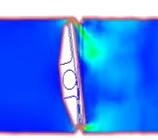
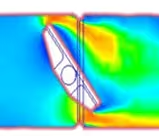
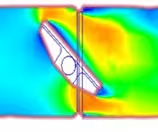
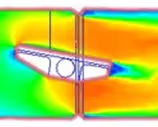
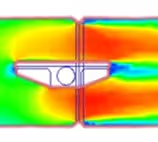
By adopting a body‑mounted sealing arrangement, Severn has increased both the longevity and reliability of the valve. Removing the seal from the direct flow path of the process media reduces wear, enabling Severn to:
- Increase effective bore size
- Maximise Cv
- Extend service life in demanding applications
Patented Oblique Cone Technology (OCT)
Using Severn’s Patented Oblique Cone Technology (OCT), the valve utilises circular sealing geometry that ensures an even seal load distribution around the circumference of the disc.
This technology provides:
- Repeatable bubble‑tight shut‑off
- Improved operational safety
- Enhanced process reliability
- Reduced downtime and maintenance intervention
Ensuring customers consistently meet their core remit of safe operations and minimum downtime.
Advanced Trims for Severe Service Conditions
The OCT geometry enables Severn to offer an extensive range of control valve trims not traditionally associated with Triple Offset Butterfly Valves.
- By utilising a one‑piece disc design, Severn can incorporate:
- Anti‑cavitation trims
- Noise‑reduction solutions
- Flow conditioning elements
- Baffle plates for severe service control
This allows the valve to operate effectively in high‑pressure drop, high‑velocity, and erosive flow conditions, where a conventional butterfly valve would typically suffer reduced service life or performance limitations.
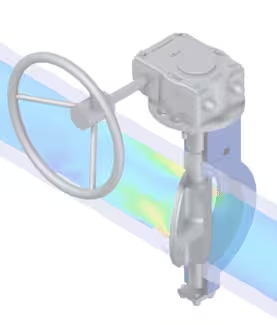
Reduced Inventory, Lower Costs, Greater Efficiency
- The OCT Triple Offset Butterfly Valve can be utilised for both control and isolation valve applications, enabling end users to:
- Reduce valve stock inventory
- Standardise spare parts
- Lower overall operating costs
- Simplify maintenance strategies
Standardised and interchangeable components further reduce spares holding requirements, delivering measurable lifecycle cost savings.
It also provides end users with the option to utilise a single valve to perform both control and isolation functions within a system, rather than two separate valves. This results in:
- Reduced CAPEX and OPEX
- Lower system weight
- Simplified piping design
These benefits are particularly critical for weight‑sensitive applications such as offshore installations, FPSOs, and platform‑based processing facilities.
Discover how Severn’s high‑performance control and isolation valve solutions can enhance your operation.